Congratulations, Your Three-Year-Old Is a Philosopher: Surviving the Endless Why Phase
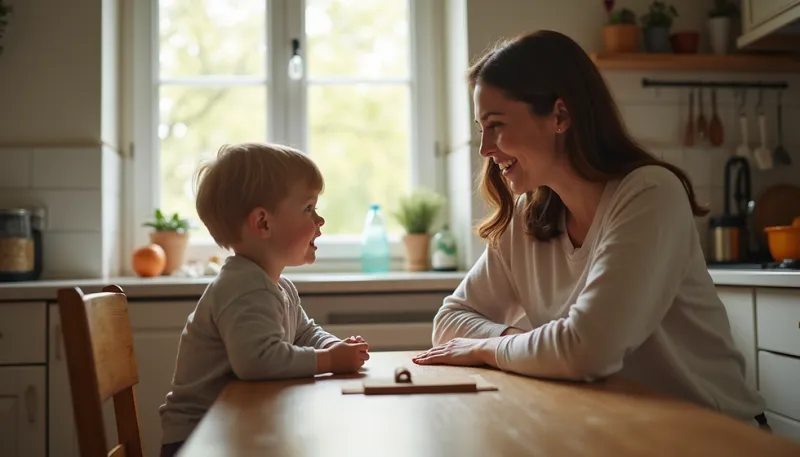
Photo: curious toddler asking question to parent at kitchen table, via static.wixstatic.com
Somewhere around age three, your child becomes an interviewer. Not a casual one — a relentless, deadline-driven journalist who has decided that you, specifically, are the source for every story on earth.
"Why is the sky blue?"
"Why do we stop at red lights?"
"Why does the dog have a tail?"
"Why?"
If you're living this right now, first: take a breath. Second: I'm going to make an argument that might feel ambitious at 7 a.m. on no sleep — this phase is a gift. One of the best ones you get.
Why the Questions Are a Good Sign
Here's what's actually happening inside that little head: your toddler has figured out that the world runs on causes. Things happen for reasons, and reasons can be found. That's not annoying — that's the scientific method in footie pajamas.
Child development researchers have found that kids this age ask questions because they genuinely want explanations, not just attention. When they ask "why" and get a real answer, they remember it. When their questions are brushed off, they ask fewer of them over time. In other words, how you respond now shapes how curious they'll be later.
So yes, the phase is exhausting. It's also a window. And windows close.
Scripts That Actually Work
You don't need to be a walking encyclopedia. You need a few reliable moves. Here are the ones I keep coming back to:
The honest short answer. Three-year-olds don't need a physics lecture. "The sky is blue because of how sunlight bounces around in the air" is plenty. Then pause. Often the pause is where their own thinking happens.
The boomerang. Turn it around: "Hmm, why do YOU think the dog has a tail?" This isn't a dodge — it invites them to build a theory, which is a bigger skill than memorizing facts. Their answers are usually hilarious and occasionally profound.
The team investigation. "I don't know — let's find out!" This might be the most powerful sentence in all of parenting. Looking up "why do worms come out when it rains" at the library or on your phone together teaches your child that not knowing is the start of an adventure, not an ending.
The check-in. Sometimes "why?" doesn't mean "explain the cosmos." It means "are you still here? Am I still interesting?" A simple "What else are you wondering about?" keeps the conversation going without you having to explain photosynthesis at the bus stop.
When You've Hit Your Limit
Let's be honest about the reality: nobody can answer questions all day. You will run dry. That's fine, and it's worth saying out loud — kindly.
"My brain needs a rest from questions for a little bit. Let's take a break and play, and we can wonder about more things after lunch."
That's not shutting down curiosity. That's modeling something just as valuable: that people have limits, that breaks are okay, and that wondering doesn't stop when the answering does. You can also hand them a notebook — a "wonder journal" where you scribble down each question for later. Kids love seeing their questions get saved like treasures, and you get a rain check on the hard ones.
The Questions Worth Savoring
Somewhere in the middle of the maddening ones, you'll get a question that stops you in your tracks. "Why do we love people?" "Why was grandma's house sold?" "Where was I before I was born?"
These are the moments the phase is building toward. Your child is inviting you into the biggest conversations of their life, starting now, at three, over mac and cheese. Answer honestly, simply, and warmly. "We love people because they make our hearts feel happy" is enough. It's more than enough.
So the next time the forty-seventh "why" of the morning lands, try to see it for what it is: not an interrogation, but an invitation. Your kid thinks you know everything. One day they'll figure out you don't — but if you play your cards right, they'll also remember that you always wondered about it with them anyway.