The 'Me Do It' Manifesto: Why Your Toddler's Stubbornness Is a Feature, Not a Bug
Let's be honest about the 'me do it' phase: it is maddening. The shoe on the wrong foot. The yogurt primarily on the wall. The forty-five-second elevator ride that becomes a negotiation because your toddler wanted to press the button and you pressed the button.
Here's the unpopular opinion I've come to hold after two toddlers and one very sticky kitchen: the 'me do it' phase isn't a behavior problem. It's a job application. And most of us keep rejecting the applicant.
What's Actually Happening in That Little Head
Somewhere between 18 months and 3, toddlers figure out they are separate people who can affect the world. That realization is thrilling and terrifying, and it expresses itself as fierce, irrational, beautiful independence. When your two-year-old screams because you buckled their own car seat strap, they're not being defiant for sport. They're telling you the most important thing they know: I am capable of things, and I need you to see it.
We tend to treat autonomy as something to manage — a phase to survive. But child development folks have long noted that kids given real, meaningful responsibilities early tend to be more cooperative later, not less. The toddler who gets to pour their own water at 2 is less likely to fight you on everything at 4, because the power struggle never had to become the default channel of communication.
Enter the Yes Zone
The trick isn't saying yes to everything. It's engineering your home so that 'yes' is the default answer in specific zones — places where your toddler's independence can run wild without wrecking your day.
The self-serve snack drawer. Pick a low drawer or bin. Stock it with two or three toddler-approved options — crackers, clementines, the pouches they'd fight a bear for. New rule: anything in the drawer, they can have, no asking required. Suddenly snack time stops being a negotiation, because the answer is always yes within the zone.
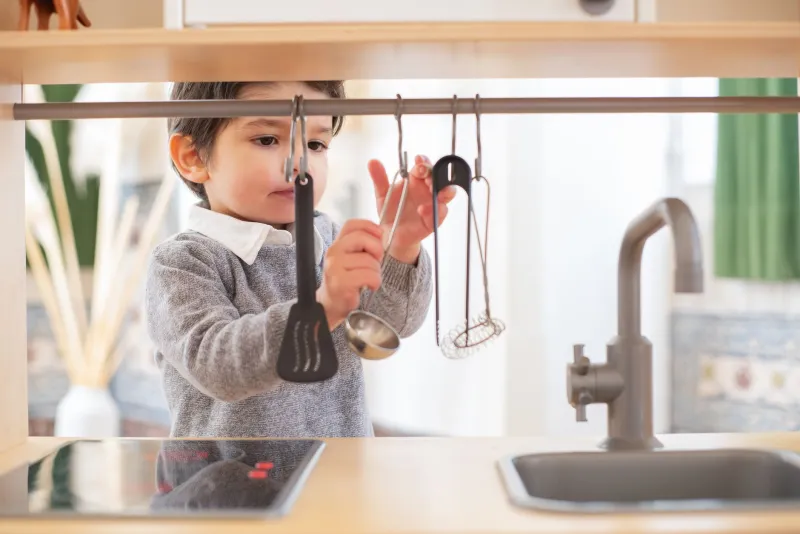
The step-stool station. One sturdy stool, permanently parked at the bathroom sink (or a second one in the kitchen). Now hand-washing, teeth-brushing, and even dish 'helping' are physically possible without a lifting assist. So much toddler frustration is just being vertically excluded from their own life. The stool fixes that.
The outfit bins. Two bins, dresser-level. You curate: everything in either bin is weather-appropriate and parent-approved. They choose: shirt, pants, the whole look. You've cut the morning outfit standoff to zero because every available option is one you already said yes to. (Yes, the pumpkin shirt will be worn four days a week. That's the price of peace.)
The 'you're the door opener' job. This one's free: whenever you arrive at any door, car, or gate, stop. Wait. Let them do it. It adds ninety seconds to every transition and eliminates roughly half of all transitions-related meltdowns. Best ROI in parenting.
The Fine Print
Yes zones are not a free-for-all. The system works because the boundaries are clear: inside the zone, you're in charge; outside it, the answer is the answer. You'll also need to make peace with imperfection — misbuttoned shirts, overfilled cups, socks that are technically on. Resist the fix-it reflex. A wobbly job done by themselves beats a perfect job done by you, every single time.
Will there still be meltdowns? Sure. Toddlers gonna toddler. But when 'me do it' has legitimate outlets, it stops being the soundtrack of your day and becomes what it always should have been: the sound of a kid figuring out they can.